

Why smoke odor persists after a fire
When something burns, gaseous substances and solid combustion products scatter in all directions. Organic materials break down into resins and a more volatile, gaseous fraction — a carbon-based compound by its chemical nature. This fraction is what produces that sharp, acrid smoke smell.
The carbon substance reacts readily with other chemical elements and quickly works its way into furniture, clothing, and even walls. This is precisely why getting rid of smoke odor in a home is so difficult. Soot and greasy residue contain toxic resins that are hazardous to health, and these resins are what give off the foul smell. Even after surfaces are cleaned of char, the biting odor of smoke can linger in rooms for five to six months.
For La Jolla homeowners dealing with fire aftermath, understanding this chemistry matters. The smell is not just floating in the air — it has bonded with materials throughout the house.
Health effects of lingering smoke
The harm to health comes not so much from the volatile components as from the resins. They hover in the air as large particles, which we see as plumes of smoke. Even in very small concentrations, smoke residue is harmful to people and pets, leading to:
- Acute poisoning, expressed as coughing, nausea, and sometimes elevated body temperature
- Deterioration of lung function from accumulated combustion products
- Increased risk of tumor formation over prolonged exposure
If metallic furniture or synthetic materials were damaged during the fire, the resins may contain heavy metals. Cleanup right after a fire should be done wearing a respirator. Children and the elderly should be taken to a safe location.
Why airing out and home remedies fall short
A common first impulse is to open windows and hope the smell goes away on its own. Airing out and regular air fresheners will only help in a kitchen when a pan has scorched. After an actual fire, things are different. During combustion, synthetic resins and charred particles penetrate deep into walls and finishing materials, and that is what produces the stench. Furniture and interior items become saturated with the acrid smoke odor, and removing it is not simple.
Air fresheners and aerosol sprays mask harmful odors from soot quickly, but only for a short time, and ventilation alone does not deliver the needed result. To fully remove the smell, you would need to strip rooms down to bare concrete — tear off charred wallpaper, pull up floors and ceilings. The space ends up looking like it did right after construction.
Popular advice relies on using large quantities of water. Water does absorb unpleasant smells to a degree. You can place buckets of water around the room and periodically pour out the dirty condensate. Hanging wet sheets and towels throughout the house helps somewhat. Wet mopping with vinegar or lemon juice added to the water also reduces odor.
But even after a thorough cleaning, you will likely still smell smoke — not as sharp as right after the fire, but still quite persistent. Beating it with traditional methods is nearly impossible. You can only mask it with pleasant scents — pine branches, live plants, aromatic candles. Despite all these efforts, anyone walking in from fresh air will still notice the smoke smell.
How professionals actually approach smoke odor removal
Professional restoration crews in the La Jolla area follow a sequence of steps that goes well beyond what a homeowner can do with store-bought products.
Step 1 — Removal of burned materials and debris
First, everything that was engulfed by fire gets removed from the house. All objects that did not burn but absorbed the smell of smoke must either be discarded or thoroughly cleaned. Partially burned materials — wooden doors, window frames, floor coverings — are dismantled and hauled away. These items will never stop releasing odor.
Step 2 — Mechanical and chemical cleaning of surfaces
Walls, floors, and ceilings are scraped and scrubbed with stiff brushes in a dry-cleaning pass first. Then every surface is washed with concentrated chemical agents — specialized formulas that dissolve soot and carbon residue, not ordinary household cleaners. For surfaces like tile and metal, professionals use cleaning creams and solvents designed to break down the greasy, resinous layer of soot.
Instructions for these chemicals must be followed precisely. They should not come in contact with skin, must not be mixed with other products (this can cause dangerous reactions), and some cannot be diluted with water or poured into plastic containers. Gloves, safety glasses, and proper ventilation are required throughout.
Step 3 — Treatment of textiles and soft furnishings
All fabric items need washing at the maximum allowable water temperature for each type of material, using a double-rinse cycle and fabric conditioner. Drying should happen outdoors if possible. Carpets go to a specialized cleaning facility. Upholstered furniture gets deep-cleaned — the upholstery itself and the padding underneath both hold odor.
Items that cannot be laundered — heavy drapes, mattresses, certain upholstery — are treated with professional-grade enzyme-based neutralizers. These work by catalyzing the breakdown of the carbon compounds that cause the smell, rather than covering them with fragrance.
Step 4 — Ozone treatment
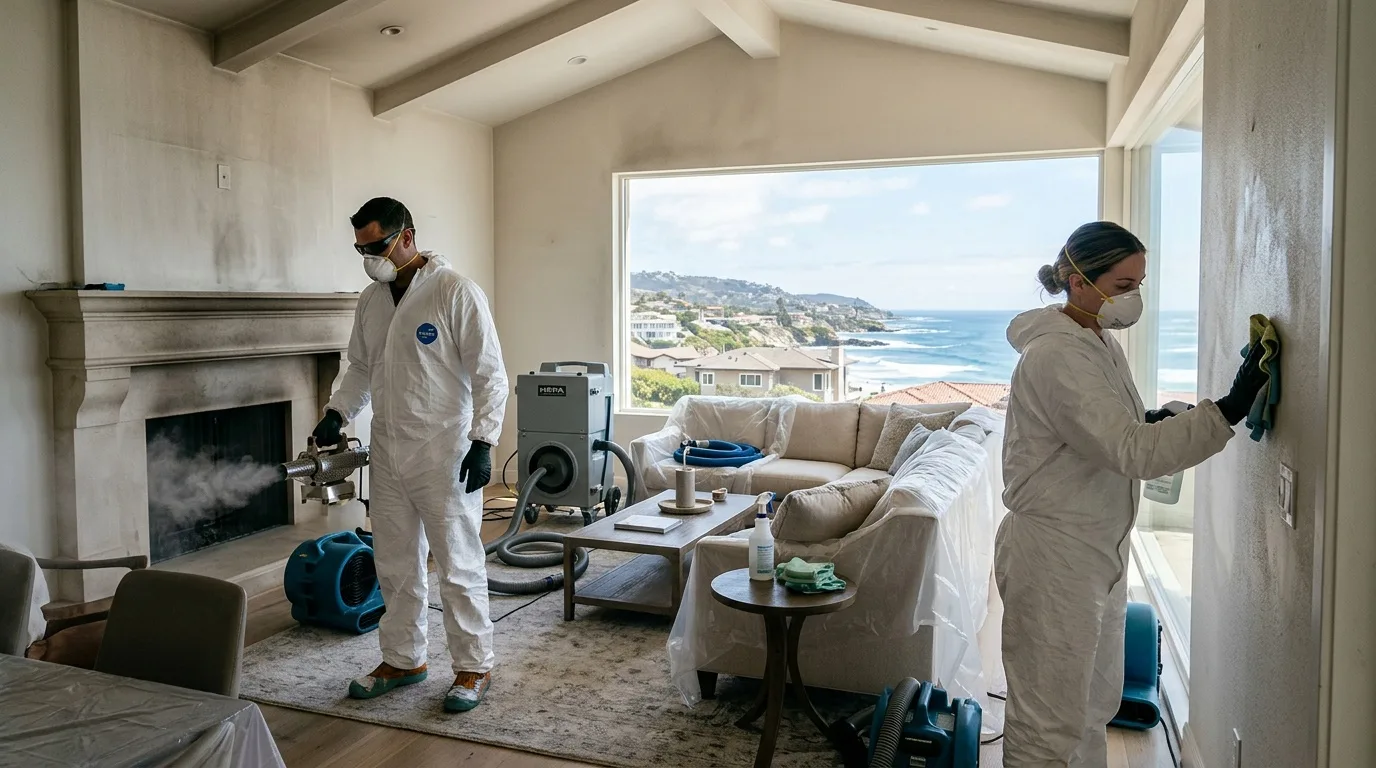
An ozone generator is placed in the sealed room and left running for several hours. Ozone does not simply mask the smell — it causes the complete breakdown of smoke molecules. The gas penetrates into cracks, fabric fibers, and porous materials that wiping cannot reach.
Ozone treatment also sterilizes the space and eliminates mold spores and insects. During the generator's operation, no one — people or animals — should be in the room. After the unit is turned off, you need to wait thirty minutes to an hour before entering.
If the smoke odor reappears after treatment, the procedure can be repeated. With an ozone generator, the air in the room typically stays clean and fresh for two to seven days, at which point it becomes clear whether another pass is needed.
Step 5 — Thermal fogging (dry or hot fog)
For cases where the fire was extensive or the smoke had time to penetrate deeply, professionals use fog generators. Cold fog involves fine-mist spraying of a deodorizing solution — this works well for localized fires where the smell has not had time to soak deep into floors and walls. Hot fog takes a different approach: the deodorizing solution is heated before spraying, which allows its particles to reach deeper into crevices and porous surfaces. This method is recommended for large-scale fire damage.
In the most stubborn cases, a combined method is used — both cold and hot fog treatments in sequence, sometimes followed by another round of ozone.
What homeowners in La Jolla should know before hiring
Southern California's coastal climate adds a layer of complexity. La Jolla's humidity can slow the drying of treated surfaces and create conditions where residual moisture interacts with soot residue. Professional crews familiar with local conditions account for this in their drying and ventilation plans.
A few things worth keeping in mind:
- Do not run your air conditioning system before professional cleaning — the ductwork may have pulled in soot particles, and running the system will redistribute them throughout the house
- Ensure the ventilation system is inspected and cleaned as part of the restoration scope
- If the fire involved synthetic materials (foam insulation, plastic fixtures, synthetic carpeting), the chemical composition of the smoke residue is more complex and typically requires the combined fog-and-ozone approach rather than a single treatment
- Ask about enzyme-based neutralizers versus chemical masking agents — neutralizers break down odor molecules, while masking agents only cover the smell temporarily
The realistic timeline
Removing smoke odor is not a one-day affair. A typical sequence — debris removal, surface cleaning, textile treatment, ozone, and fogging — spreads over several days to a week or more depending on the extent of the damage. Severely affected homes may need multiple rounds of treatment spaced days apart, with air quality checks between sessions.
The persistent nature of fire smoke means that anyone entering the house from fresh outdoor air may detect a faint trace of odor even after professional work. Complete elimination sometimes requires patience and a willingness to repeat certain steps. But the difference between a properly treated space and one where only surface cleaning was done is dramatic — in the latter case, the smell remains for months and continues to pose health risks.