

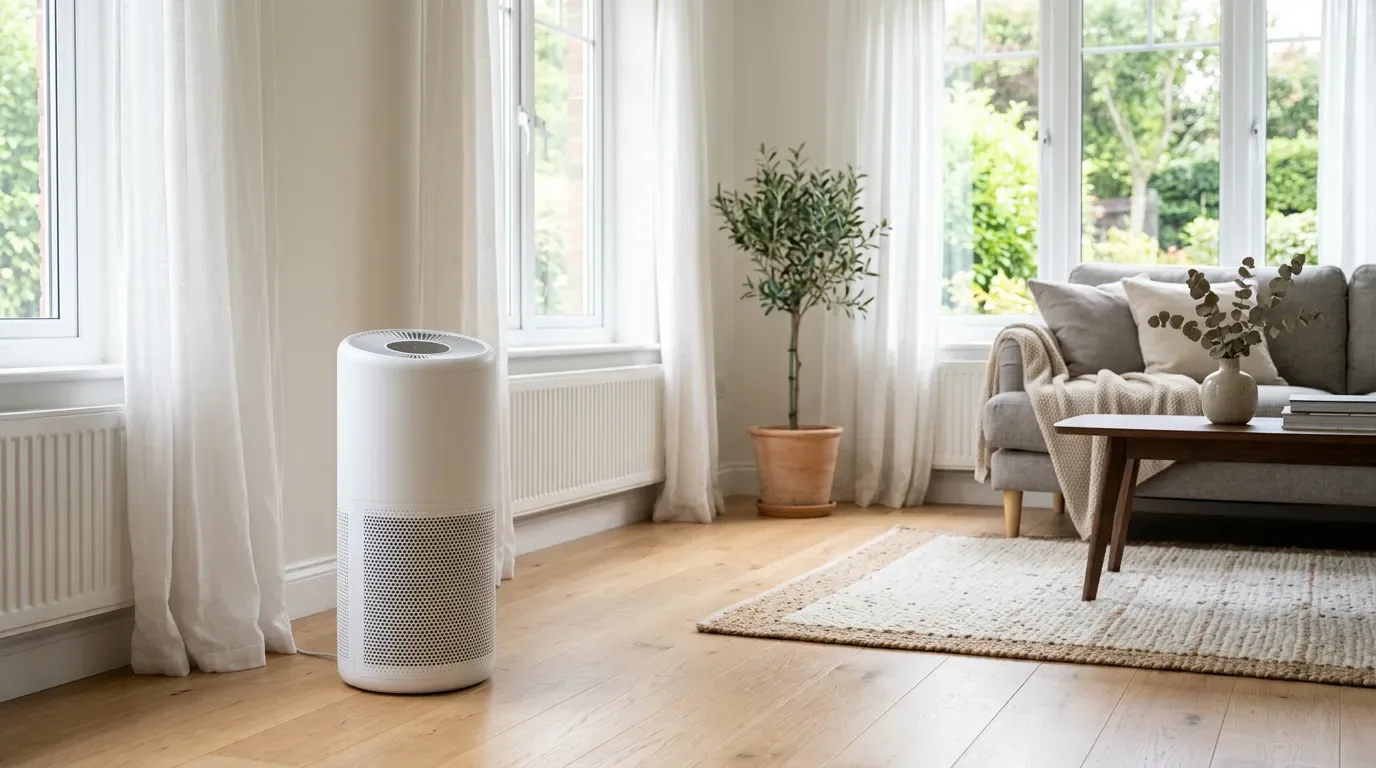
An air purifier is often bought as a universal fix, "so it's easier to breathe at home." But it covers only part of the job. Some problems it handles well, others it does not touch at all, and the money goes nowhere. With mold this shows very clearly.
Below is how a purifier actually works, what a HEPA filter catches from mold, why it does not fix the source, what it does with the smell, how to size and place it, and where it fits after the mold is removed.
How an Air Purifier Works
An air purifier does not bring new air into the house. It takes the air that is already in the room, runs it through filters and sends it back — and so on, in a circle. This is recirculation: the unit has no connection to the outdoors, and you don't need to open windows for it to work. Remember this. Both the usefulness of a purifier and its limits grow from here.
Cleaning speed differs from unit to unit, and it is described in different ways: some list the airflow, others the room size the unit can handle. The principle is the same for all of them, though. Air is driven in a circle through filters. So what decides is not the housing or the lights, but which filters sit inside.
The Filter Stages
Household units usually have three stages, and each one is responsible for its own part.
- Pre-filter. The coarse first stage. It holds the big stuff: pet hair, human hair, fluff, large dust. Its job is to keep all of that from clogging the fine filters. The pre-filter is washed or replaced — once it is clogged, it starts passing dirt further on itself.
- HEPA filter. Works with small solid particles — dust, pollen, mold spores, fine PM2.5 dust (particles smaller than 2.5 microns), the very ones that go deepest into the airways.
- Carbon filter. A separate stage for gases and odors. Activated carbon holds volatile organic compounds: kitchen smells, tobacco smoke, fumes from furniture and fresh finishes. It does not work with solid dust — that is the HEPA filter's job, and the HEPA, in turn, does not hold gases.
What a HEPA Air Purifier Captures From Mold
In the US, a true HEPA filter captures at least 99.97% of particles 0.3 microns in size; filters sold as "HEPA-type" or "HEPA-like" do not have to meet that bar. Important to remember: a HEPA filter is disposable, it clogs over time and is replaced on the manufacturer's schedule.
The filter is made of a long sheet of fibrous material that is folded many times into an accordion.
Manufacturers do not recommend trying to wash HEPA filters. The point is that drying them fully is very hard because of how the fibers are built. And mold quickly takes hold in a damp filter, and it starts working against you.
This is the main strength of an air purifier for mold spores. The HEPA filter holds airborne dust, pet hair and skin flakes, plant pollen, mold spores — the things allergy sufferers react to most sharply. While the unit runs, the concentration of these particles in the air goes down, and so there are fewer irritants that set off a runny nose, itchy eyes and attacks in people with asthma. But this is support, not treatment. If symptoms hold on, take them to a doctor or an allergist, not to the store for a second unit.
Where the Limits Are
- Only while it is on. The purifier cleans only the air it manages to pass through itself, and only while it is switched on. Switch it off and particles build up again.
- Only what is in the air. It works with airborne particles, not settled ones. Dust on shelves, allergens in pillows, carpet and curtains — it will not reach them.
- Not all of it. Buying a purifier will not necessarily ease allergy symptoms. Getting rid of allergens 100% will not happen.
Why an Air Purifier Does Not Fix the Source of Mold
A purifier does not humidify or dry the air — that is simply not its function. If the house is damp and mold is setting in, the unit will not cope with it. The EPA says the same about the whole category: its EPA guide to air cleaners and filters in the home notes that portable air cleaners and HVAC filters can reduce indoor air pollutants but cannot remove all of them.
Mold spores get into porous materials — furniture, textiles, insulation — with air currents. They settle on surfaces and are absorbed by the materials, where they stay viable. A mattress or suede upholstery, for example, collects spores, which are then released into the air again with movement. Spores can stay viable in dust and textiles for a long time, even after the visible source has been removed.
Surface cleaning of a wall does not destroy all the spores, and closing the wall up creates a hidden mold source. Spores left in the wall or the insulation keep getting released into the air through micro-gaps or pores. Spores that got into porous materials start to grow again with high humidity. No filter in the room can do anything about a source like that. It is removed through professional mold remediation and cleanup, and if the moisture came from a leak, the wet materials go through water damage restoration and drying first.
Drying a moldy wall with a fan without first isolating the work area spreads the spores. The fan pushes spores from the mold source into the air, where they are carried through the whole home — spores are light and travel easily on air currents — and then settle on surfaces and get into furniture and textiles.
Do Air Purifiers Help With Mold Smell?
The carbon filter is responsible for odors. Carbon is a good absorbent, it soaks up most unpleasant smells. In the purifier's design carbon filters go last, so that no dust, dirt or hair reaches them. The filter cannot be washed, only replaced. How often depends on the manufacturer; usually every six months to a year is recommended. Carbon wears out: once it is saturated, it stops holding smells, and the filter is due for a change.
And here is the catch. The unit removes the smell, not its cause. If the house smells of damp or mold, the purifier will muffle the smell, but the source — humidity and a lack of ventilation — stays. Roots like that are dealt with not by filtration but by air exchange and drying.
Thanks to several layers of filtration inside, a purifier with a carbon filter also helps with smoke smell. Smoke odor left after a house fire is a separate job, though, and it is covered on the fire damage restoration services page.
Be careful with units that use ozone. Ionizers and electrostatic precipitators can be hazardous because they produce ozone, and a high level of this gas in the air can lead to lung problems. A UV layer can produce unwanted ozone too. Stores also sell so-called ozone generators. For home use there is no point recommending them: the downsides seriously outweigh the benefits.
Air Purifier Size and Placement
It is important to buy a unit powerful enough for the cleaned air to circulate around the room normally. Otherwise the air will be clean only next to the unit.
Performance is the volume of air that passes through the purifier, and US specifications list it as CADR, in cubic feet per minute. You can work out the room's volume in cubic feet by multiplying its height, width and length. Multiply the number you get by 4 and divide by 60: the common recommendation is that the air in a room passes through the filters at least four times an hour. You don't have to do the math when choosing, though — the manufacturer always lists the approximate room size in square feet the model is rated for.
- One unit or several. If you plan to put a unit in each room, choose each one for that room's size. If the purifier will be carried from room to room, go by the area of the largest room.
- Away from the window. A purifier is a fairly large appliance that needs a spot in the room. It is better placed away from the window, so nothing interrupts the airflow.
- Keep the intake clear. Do not let a rug, a curtain or furniture block it.
- Windows closed while it runs. Otherwise the effect won't be noticeable: the cleaned air is blown back outside, and dirty air comes in too fast for proper filtering. If you can't do without outdoor air even while it runs, pick a model rated for a larger area — such units have higher performance.
Dehumidifier or Air Purifier for Mold?
These devices do different jobs. If the house is damp and mold appears, a purifier will not handle it — humidity needs other devices, and often plain ventilation. A purifier is for what is already floating in the air: particles and odors.
To keep mold from coming back, humidity is controlled with dehumidifiers. The optimal humidity is 40–60%. For mold and mildew in a damp room, the dehumidifier deals with the moisture, and the HEPA air purifier only catches what is in the air.
Using an Air Purifier After Mold Remediation
If mold spores have spread through the air and gotten into porous materials, the answer is professional decontamination with HEPA filters and isolation of the work area. Household methods do not work in this case. Wet cleaning, for example, does not destroy spores in porous materials such as a mattress or suede upholstery — it only lowers their concentration for a while.
Home mold tests may not detect all types of spores, especially in the air. That takes professional testing that accounts for the baseline spore levels in the area. Check the condition of the wall as well: even after it has been closed up, spores can remain in the insulation or in micro-gaps.
Typical mistakes:
- Underestimating the risk. Ignoring how spores spread when mold is worked on mechanically without isolation.
- Surface cleaning. Swapping full removal of contaminated materials for surface cleaning.
- No humidity control. Not enough control of humidity after the work leads to the mold coming back. How long the materials take to dry is covered in our guide to drying out a house.
After the work, a purifier is useful for what remains floating in the air. Just keep in mind that its effect exists only while the unit is on and only with airborne particles — settled dust is removed by cleaning. Filters are consumables: the pre-filter is washed, the HEPA and carbon filters are replaced on schedule, otherwise there is no cleaning.
More on moisture, mold and drying is in the restoration articles on our blog. You can also read about our restoration company, see reviews from local homeowners, or go back to the water, fire and mold restoration home page.