

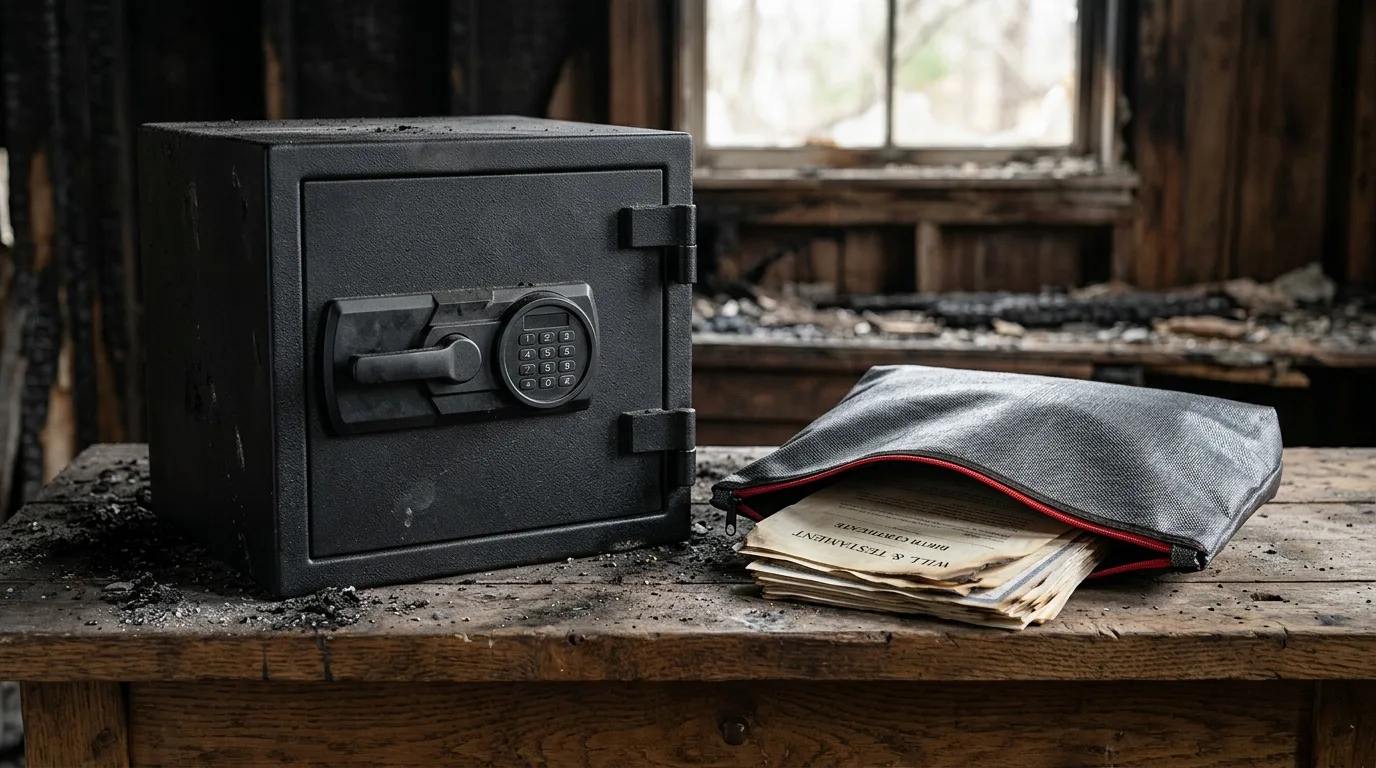
Jewelry, money and important documents are in every household, so the question of where to keep all of it is a real one. A bank safe deposit box is a reliable place, but it is not very convenient, and people want to keep their things closer. A safe at home is the best option in that case.
The main enemies of what you have put aside are fire and thieves. So two main kinds of safes are widespread: fire-resistant and burglary-resistant. Universal models are often too expensive and too big, so this article won't dwell on them.
Besides money, your house almost certainly holds important papers, documents and family heirlooms. Losing them can do serious harm, and not only to your finances. Photos, letters and other documents that matter to you are better protected in advance. The best way out here is a fireproof safe for documents, with fireproof concrete filling the space between its walls. Against a break-in this kind of safe doesn't help much. Against fire, it does.
How a fireproof safe is built
A fire-resistant safe works like a thermos. Double steel walls with a layer of fire-resistant material between them are paired with a special door that has a heat lock.
The body and the door are two walls welded together, and the space between them is filled with fireproof concrete. This concrete has a fine-pored structure, and that is what gives it low thermal conductivity. The fire rating of the safe depends directly on the properties of this concrete. At the same time, its strength is, unfortunately, low. It can't protect even against a light hand tool.
No loose material, like quartz sand, can give the needed fire resistance. Modern safes are rather "poured": liquid concrete is poured into the body and then hardens.
The hardest place to make fire-resistant is around the door seam. To get the needed properties there, makers use one of two things:
- A heat lock. A complex door rabbet made of several steps.
- Swelling seals. Heat-insulating gaskets that expand when heated.
A few outside signs of quality also help. Seams and joints on the body should not be visible, and the gap between the door and the body should be as thin as possible. The door should be about twice as thick as the walls.
What fire-resistance ratings mean: time and temperature
When a fire resistant safe rating is assigned, testing labs look at two parameters. The first is the time in minutes during which the temperature inside the body won't go above the critical value for what is stored. On the label this is shown as a number, for example 60 or 120. The second is the type of contents. One class covers cash and paper documents. Another covers all of that plus magnetic disks and tapes, film and photo negatives.
For reference: paper is damaged at about 350°F, while for modern digital media the upper temperature limit is about 125°F. So a safe rated for paper and a safe rated for flash drives and hard drives are not the same thing.
How the fire test is done
The sample safe is placed in a furnace. The furnace is heated to about 1,700°F and the temperature is watched. Inside the safe are the items whose protection is claimed: paper, banknotes, magnetic tapes, disks. The heat acts on the safe for the time that matches its fire rating. If over the claimed 60 or 120 minutes the temperature inside did not pass the threshold, the stage is passed. Damage to the contents, or the limit temperature reached at any monitored point, means the safe failed.
Some tests are tougher. Paper documents are put inside, the safe goes into a furnace at about 2,000°F and is held there for a short time. Then it is dropped from a height of about 30 feet, cooled, and heated again. If the document inside is still readable after all of this, the test is passed.
Check the rating, not the word "fireproof"
Not every metal box with a lock is a safe. Whatever the box looks like, to be called a safe it has to meet set industry standards and pass testing. Without that it isn't a safe, it's an iron box with a lock. Many sellers call metal file cabinets safes, so when buying, check the rating. It is more reliable than the claims of a careless seller.
In the US, look for an independent fire rating on the label, such as UL 72 Class 350 1-hour for paper. If you insure what is in the safe, the insurance agent may ask about the rating too.
Fireproof document bag vs safe
The two do different jobs, and so do the different kinds of safes.
- A fireproof safe for home. The best option for a house is a 60-minute safe rated for paper. It fits letter-size documents easily, needs no tricky wall or floor mounting, isn't too heavy (about 90 lb) and is quite compact. These safes have one serious drawback: weak protection against a break-in. In some cases thieves simply carry it off.
- A burglary-resistant safe. These are not put in a furnace when tested. In a strong fire, the contents of such a safe, even one with some fire-resistant properties, will turn to ash.
- A light cabinet safe. A cheap, light safe that sits in a closet or other furniture is meant for medicine, small amounts of money or not very important documents. It won't stop an experienced burglar, but it is handy for quick everyday use.
- A briefcase or document bag. For the most important documents. A briefcase is faster to grab in case of a fire.
A bag makes sense only if there is time to take it. A safe stays where it is.
In case of fire, leave the safe. Life and health are worth more than anything stored in it. Don't waste time carrying out valuables if everything around you is burning.
Water from firefighting
A fire is put out with water, and papers have to survive that as well as the heat. A few rules for storing them:
- Fire-resistant safes or cabinets. Use them for permanent storage of important documents.
- Moisture-resistant containers. Put receipts in them. Clear plastic sleeves and containers with lids protect against moisture and dust.
- Metal cabinets. They keep papers safe from mechanical damage.
- Locks and bank boxes. Keep valuable papers in safes with reliable locks or in bank safe deposit boxes.
If you are choosing a waterproof fireproof safe, the same habit still helps: papers in sealed sleeves inside the safe.
What to keep inside
Before you put documents into folders, figure out what really needs to be kept and what can be thrown away. Then sort them by category:
- Personal. Passports, certificates.
- Financial. Contracts, bills.
- Medical. Records and statements.
- Property. Documents that establish ownership of a house or condo are kept forever.
Put the originals in a separate organizer and arrange them by date to make searching easier. Make a list showing where each document is. It makes your home archive easier to search and keep track of.
Don't keep extra things in the safe: bank cards, keepsake letters, trinkets that are dear to you. Thieves will try to carry the safe off, and it would be a shame to lose those things together with the money. Don't keep everyday cash in it either. The less often you need to open the safe, the better.
Digital copies
Digital copies are handy if you are often away from home. You always have access to important files and don't need to ask family to look for something. There is no point scanning everything. It is enough to digitize the important documents you use most often.
The simplest format is PDF. It always opens, the quality doesn't degrade, and it can be viewed in any browser.
- Keep three copies. Two on different devices and one in the cloud.
- Cloud storage. Saves files from any device automatically, and a certificate can be found from a phone, not only at home.
- External drives. Flash drives and hard drives help if a cloud service fails.
- Passwords. Use strong, unique passwords for each storage account and change them regularly, and turn on a second check at login. Watch who has access rights.
For a list of records worth copying, see Ready.gov's financial preparedness page.
Paper and digital archives are two approaches that work well together. Originals go in reliable places; copies go on three devices.
Where to put the safe
So that burglars don't steal the safe along with its contents, it has to be either big and heavy or fastened to the wall or floor. Before you go shopping, figure out where you will put it.
- Under a bed. A small safe there has to be bolted to the floor.
- In a closet. It has to be fastened directly to the wall, so thieves don't cut out a piece of the furniture together with the safe.
- In a wall. Setting a safe into a wall the way it's done in movies doesn't work everywhere. Interior walls can be thin, there may be wiring under the finish, and the wall itself may be drywall.
After a fire: heat-damaged safes and papers
Look at how the fire test ends. The furnace is turned off, and the safe stays in the closed furnace until the furnace and the safe cool down to room temperature. Only then is it taken out, left to cool naturally, opened, and its parts and contents inspected. After a house fire, the same rule holds: don't open a safe that is still hot, because air rushing in can make heated papers catch fire.
What survives depends on which safe it was. A fire-rated safe is built to keep paper below its ignition point for the rated time. In a strong fire, the contents of a burglary-resistant safe, even one with some fire-resistant properties, will turn to ash.
If the keys are lost or the code forgotten, representatives of the manufacturer can open the safe carefully for a fee. Keys can be restored through the maker, since each lock has its own number.
The house itself is a separate job. For that side, read about fire damage restoration after a house fire, packing out and storing your belongings and water damage restoration after firefighting. Smoke stays in a house long after the fire, and there is a separate guide on how professionals remove smoke odor. You can also learn who we are and how we work, read what La Jolla homeowners say in reviews, browse more articles on our blog or go back to our La Jolla restoration homepage.