

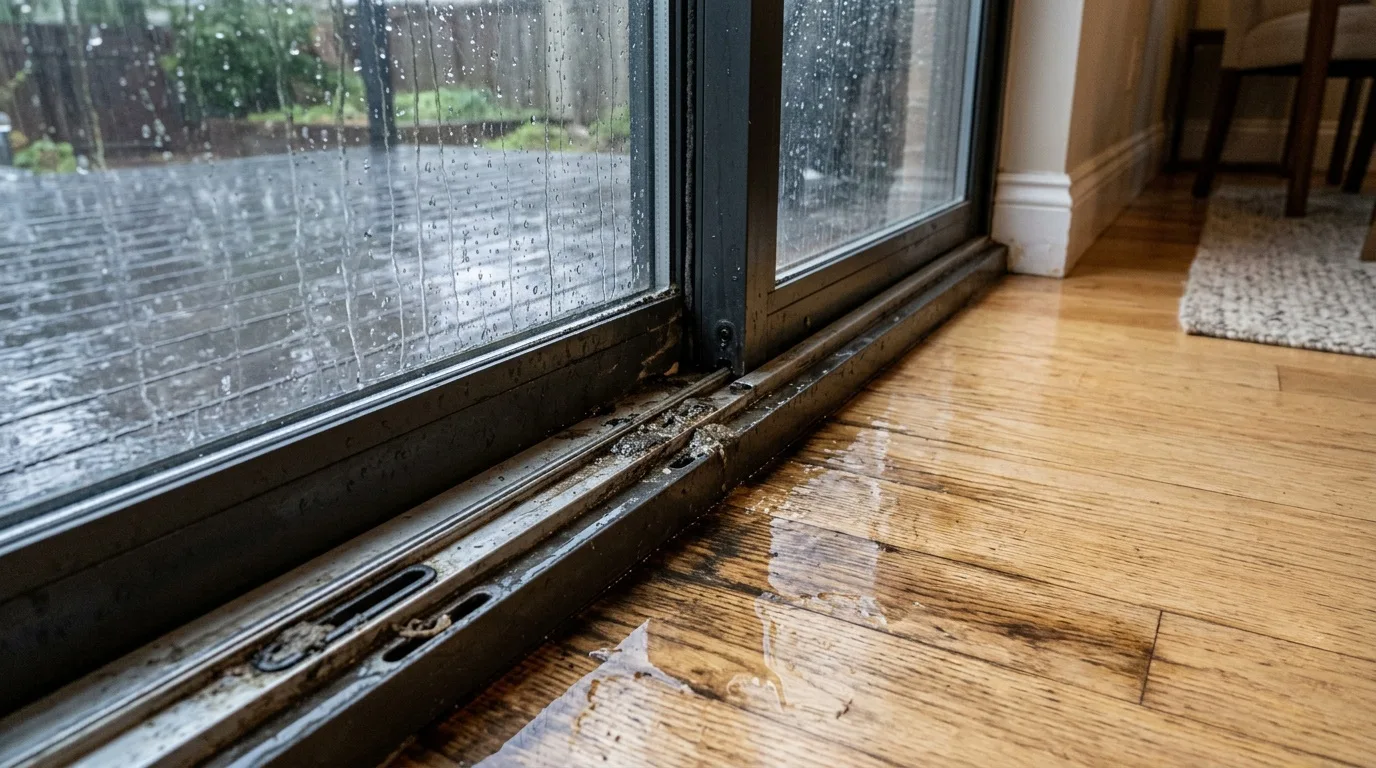
Every homeowner with a sliding glass door sooner or later has the same worried question. What happens in a slanting downpour? Will the living room turn into a pool?
The short answer is that water should not get in: the track is built to collect it and let it out. The bottom track is a system of drainage channels and collection troughs that is supposed to catch the water before it reaches the inner line of seals. When a sliding glass door is leaking anyway, one part of that system has stopped working. A correctly built joint can handle even a sudden heavy rain, but it needs very careful preparation of the base. Get it wrong, and you really do end up with a permanent puddle by the door.
Below are the usual reasons a sliding door leaks when it rains, in roughly the order to check them, and what the water does to the floor once it gets past the frame.
How the Track and Threshold Are Supposed to Drain
On a typical slider, the bottom track is a channel: water that gets into it runs out through weep holes on the outside face of the frame. Lift-and-slide doors with a flush threshold hide the same channel below the floor.
As long as the water can get out, it does not matter much how much lands on the rail.
Blocked Weep Holes and a Dirty Track
The weep holes are slots in the bottom of the frame that let water drain out of the profile. They clog with dust and leaves in one or two seasons. After that the water simply stands inside the profile. This is the most common reason for a sliding glass door leaking in the track: the track fills like a gutter with a plugged downspout, and the water goes over the inner edge onto the floor.
The same applies to the bottom track as a whole. Water and debris collect there, and the drainage openings have to keep working. The track needs to be cleaned of sand and dirt; otherwise the rollers grind it down within a couple of seasons, and a worn track holds water in places it was never meant to.
Sliding door weep holes also get blocked from the outside. A common renovation mistake: the floor outside is raised too high. After the tile goes down the level comes up even more, and the drain openings at the bottom of the door profile end up partly or fully covered. The drainage channels built into the profile can no longer empty, and water ends up in the room. If you notice a sliding door leaking water at the bottom only after a patio was re-tiled, look at this first.
Do not drill extra holes in the door profile yourself without checking how it is built and getting the go-ahead from the manufacturer or a door installer. The wrong intervention can break both the drainage and the seal of the profile.
Worn Seals
If the drains are clear, the next suspect is the seals. How tight a sliding door is depends a lot on its mechanism.
On a typical slider, the panel always rides on rollers, and at the bottom there is a gap covered by a brush. Brushes keep out wind, but not warmth, and they are not a full seal against water. An insulated door is set apart from a basic slider by a continuous seal around the whole panel, not brushes. When that seal is torn, flattened or has come out of its groove, water that the wind pushes against the glass finds its way in.
Flashing and Installation
If a door leaks after every rain even with clean weep holes and good seals, the cause is usually the installation: a missing or failed sill pan under the threshold, flashing that does not overlap correctly, or a patio surface built up too high or sloping toward the door. Fixing that means pulling the door, which is a job for a door installer.
Wind-Driven Rain
Water is a tricky enemy. If the patio floor is perfectly flat or, worse, slopes toward the house, water will come inside past any threshold. Water finds a hole.
The patio surface should sit lower than the floor inside and slope away from the door; where the two are level, a drain along the door helps.
- Canopy. An overhang over the door keeps rain off the joint.
- Reverse slope. Decking or tile outside should be laid with a slope of 2 to 3 degrees away from the house.
- Drainage channel. A trough with a stainless steel grate is set along the whole glazing, flush with the patio, and connected to the storm drain. Water running down the outside of the glass does not collect at the seal; it falls straight through the grate. It also catches water running across the tile and rain splash. This is the first and strongest line of defense.
If the patio is enclosed, these requirements can be relaxed. If it is open to every wind, the drainage channel is a must. This is the situation where a sliding door leaks when it rains hard from one direction and stays dry in calm rain.
Quick Fixes
Some things an owner can check before calling anyone:
- Clean the track. Dust and sand are removed with an ordinary household vacuum or a damp cloth.
- Clear the weep holes. They clog with dust and leaves in a season or two; once they are clear, water should stop standing inside the profile.
- Look at the outside floor. Check whether tile or a new layer of patio covering has crept up over the drain openings at the bottom of the door.
- Check the seals. Look for torn, flattened or loose sections, especially at the bottom of the panel.
A sliding glass door leaking from the top is a different matter: a track and weep holes will not explain it, and it points back to how the door was flashed and installed into the wall.
Damage to Flooring and Subfloor
When water has been getting past the door for a while, the trouble is no longer only at the threshold. Fixing installation mistakes after the floor is finished can mean removing the tile, redoing the mortar bed and doing the waterproofing again.
Water standing inside the profile and under the covering does not dry on its own quickly. The key to mold control is moisture control, and wet materials should be dried quickly; for more, see the EPA's brief guide to mold and moisture. If the floor near the door has swollen, smells musty or stays damp, the subfloor needs to be checked and dried by a pro, not just the surface wiped. For how long that drying usually takes, see our guide to drying out a house.
When to Call
If the drains are clean, the seals are intact and water still shows up on the floor after rain, the cause is most likely in the installation or in the floor around the door, and the exact source often cannot be found without opening things up. Wet subfloor and baseboards are a job for professional water damage restoration in La Jolla, and a musty smell or dark spots near the door call for mold remediation for damp floors. If furniture and rugs have to be moved out while the floor is dried, our pack-out and contents protection services cover that part.
You can read more about our restoration team, see what La Jolla homeowners say about us, browse more water damage articles on our blog, or go back to the restoration company home page.