

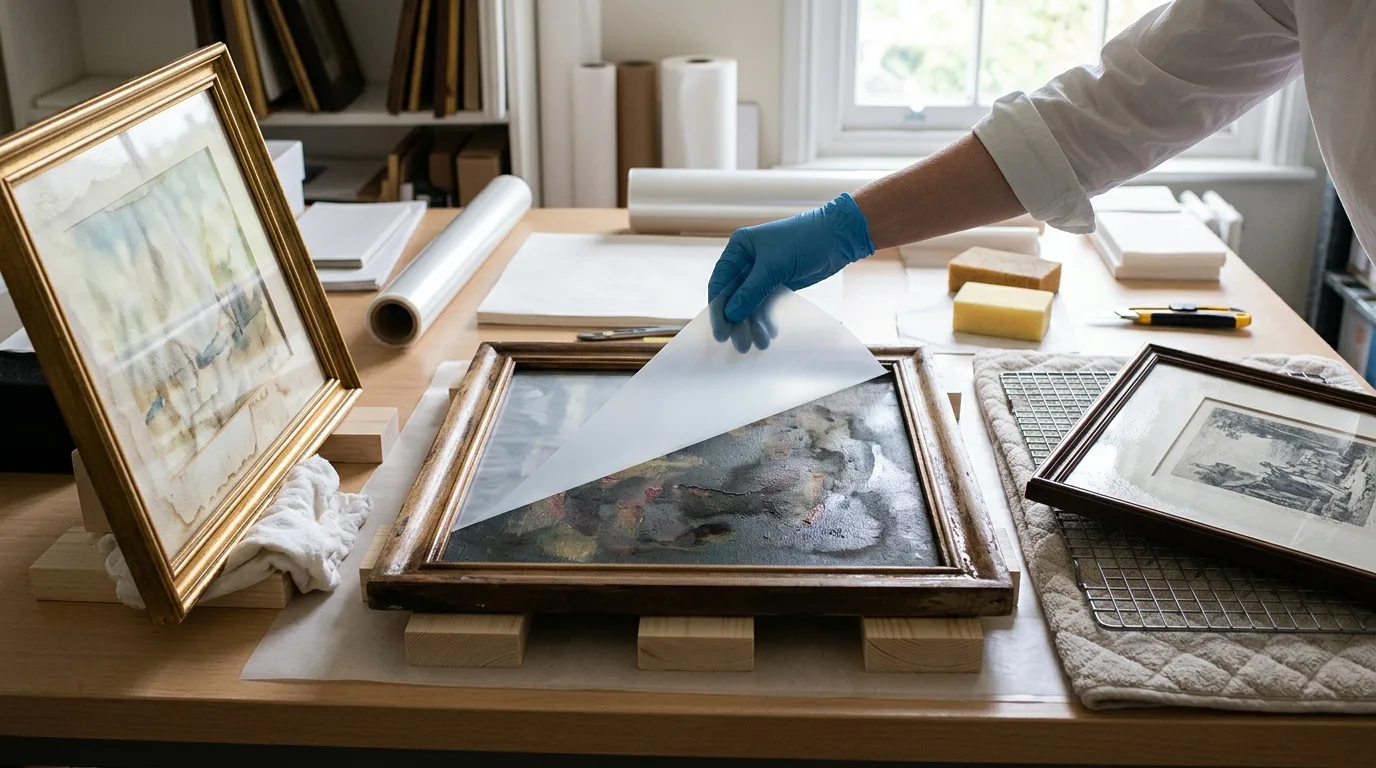
Water damage is one of the most serious things that can happen to a collection of paintings on canvas. As a rule it comes from a flood, a leaking pipe or an attempt to put out a fire. The most significant harm from water happens quickly, so every possible step should be taken to keep paintings from contact with water. Pipe leaks and winter storms are worth keeping in mind, in La Jolla homes as anywhere else.
The information below is useful for drawing up an action plan for an emergency, for preparing for one, and for reducing possible damage in cases where the water has already reached the paintings. It is first aid only. A water damaged painting of real value should be seen by a conservator as soon as that can be arranged.
How Water Damages a Painting
Paintings are made of many different materials, and these react to moisture in different ways. Wooden frames swell and press on the stretcher. The stretcher swells too; it can warp or twist, and because of that the canvas can lose its shape or even tear. On top of this, canvas shrinks hard when it gets wet, and that can cause the paint and ground to crack, cup and flake.
The shrinking of a wet painting has to be stopped by immediate, controlled drying. Soaked paintings are usually especially vulnerable, so help from a conservator should be sought as fast as possible. If that is not possible, the steps described here can be done by a non-specialist.
The First 48 Hours
The top priority is getting water off the paintings. Tilt each painting so the water runs off from a corner of the frame. If many paintings are affected, it is important to set priorities. Not all paintings react to water the same way:
- Most valuable first. Attention goes first to the most valuable paintings in the collection (their value should be decided in advance and written into the emergency plan).
- Lightly affected next. Then come the paintings that the wetting has not had time to affect much, or that are only slightly damaged.
- Worst damaged last. The most damaged paintings are left for the end. They will need the most attention and time to deal with.
Once the water has run off the canvases, dehumidifiers can be used. Do not let the air humidity in the room drop too fast, so the paintings do not over-dry. How fast the rest of the house dries is a separate question, covered in our guide on how long drying out a house takes. The building itself is handled through water damage restoration of the home, and the paintings should not go back into those rooms until that work is done.
Materials to keep on hand
- Blotting paper. A large amount of absorbent paper (100% cellulose, acid-free, the widest width available).
- Cloth or clean newsprint. Plain, unprinted sheets.
- Rigid boards. Large sheets of a hard material such as plywood or fiberboard that can be cut to the size of each painting's stretcher.
- Fans. Large ones.
- Work tables. Enough to lay the paintings out.
- Weights. For example bricks, heavy books, bottles filled with water.
- Large pieces of fabric. To cover the table.
- Film. Mylar or plastic sheeting about 4 mil thick.
Handling: Flat, Face Up, Hands Off the Paint
If possible, set up the work area in a separate room, not where the collection is kept and not one that was flooded. Put fans in the work area. Strong air circulation keeps mold from forming and speeds up drying. The fans should run around the clock until the paintings are dry.
Prepare a clean, dry, soft surface. For paintings with a flat paint layer, a few layers of absorbent paper are enough. Paintings with impasto need extra padding, fabric for example. The extra layer should be at least twice as thick as the paint layer. Cover the padding with Mylar or plastic film so it does not get damp. This keeps the chance of mold down and prevents the painting from picking up dirt or dye from the fabric.
Make sure the supporting and absorbent layers are perfectly smooth and have no folds. Any unevenness under pressure can print itself onto the painting.
If the paint on a painting is flaking, peeling or curling, or the paint or ground has softened or dissolved, lay the painting face up and do not touch it while it dries. Nothing should be blotted or pressed against the paint.
Two more limits apply:
- Tears. If the painting has tears, it may not be possible to flatten them. To avoid creasing the canvas, do not put pressure on tears that cannot be smoothed out easily and safely.
- High impasto. Paintings with high (over 3/8 inch) or brittle impasto may need extra precautions. Under paintings with sturdy impasto, put a thick enough layer of soft material such as fabric or felt to give the paint layer additional support.
Keep the paintings under constant watch so that any twisting is noticed in time. Note: if paper sticks to a painting after drying, do not try to separate it. Leave that to a conservator.
Framed Works Under Glass
Take the painting out of its frame. Remove the backing board and the hanging hardware from the back of the stretcher so there is free access to the back of the canvas. A wooden frame that has swollen keeps pressing on the stretcher for as long as the two stay together, so the frame and the work should dry apart from each other.
Works on paper, photos and prints under glass come out of the frame if they come free easily. If the paper is stuck to the glass, leave it in the frame and let a conservator separate it.
Works on Paper vs. Canvas
Paintings on canvas suffer above all from shrinking and from the warping that follows. Warping of a canvas can show up in many ways, and how much depends both on the materials and on what caused the change. It happens:
- From the room's conditions. From changes in the room and from sudden shifts in temperature and air humidity.
- From mechanical stress. From physical pressure on the canvas.
The most common forms are:
- Sagging. The canvas loses tension.
- Large waves. Broad undulation across the surface.
- Overall rippling. Fine corrugation over the canvas.
- Corner draws. Diagonal puckers running from the corners, and others.
These defects come mostly from changes in temperature and air humidity. They do not need to be fixed right away, since once normal conditions return they may correct themselves. Under high humidity the canvas takes on moisture and slackens. How it slackens depends on how well the painting was stretched and how evenly the ground and paints were applied. If the canvas was tightened while it sagged, then when the old conditions come back it will tighten even more, and cracks and tears can form. This kind of warping should be corrected by a conservator, and only after a fairly long time has passed and the defects have not straightened out on their own.
Works on paper and paintings that were never stretched behave differently. Dents, bulges and bubbles from things pressing on the canvas often shrink or go away when the painting lies on a flat surface, free, for a long time.
What correcting warped canvas involves
Correcting sagging, rippling or folds means working the stretcher keys, restretching the canvas or pressing it from the back. This is conservator's work, not first aid, and it is done only when the paint is not lifting from the ground and there are no cracks, losses and the like. If a painting has those problems, the defect has to be corrected together with consolidating the paint layer and ground.
Mold Risk
Mold on a painting usually comes from drying that is too slow or from a wet work sealed away from air. That is why the fans run day and night and why the padding under a painting is covered with film. Arrange for a conservator to examine the damaged paintings as soon as possible, to judge the extent of the damage, get further instructions on restoration and head off possible mold. If mold has already spread through the rooms, that is a job for mold remediation in the house, separate from the care of the artwork.
When to Call a Conservator
Per FEMA's guide to salvaging damaged family treasures, prepared with the Heritage Emergency National Task Force, objects that were touched by sewage or chemicals need a professional. For valuable or historic pieces, consult a professional conservator.
Water damaged painting restoration usually covers problems like these:
- Canvas damage. Abrasion and tears in the canvas.
- Lifting paint. Problems with the ground or paint separating.
- Varnish. Stains on the varnished surface.
- Liquid and fire. Restoring areas of a painting that were flooded with liquid or damaged by fire.
- Restretching. Moving the canvas onto a stretcher.
- Cracks. Closing cracks in the paint.
Water damaged art restoration takes particular skills and patience. Its stages fall into two groups: technical and artistic. The technical work includes consolidation, which means strengthening the ground and its bond with the surface it sits on; correcting deformations of the surface such as dents and waves; restoring the back of the painting, which often needs work as careful as the front; and restretching the canvas or restoring it on its original stretcher, often done with oil paintings. The artistic work has to be as exact as possible. A restorer who knows different painting techniques carefully restores the damaged areas.
Before setting the cost, a restorer first examines the painting closely and finds the problem areas, then draws up a plan for restoring the canvas and the image. The price depends directly on how complex the restoration is, how much time it needs and how many processes are planned. Even a piece that looks beyond saving is worth showing to a conservator.
Storage During Restoration
The flooded room must be cleaned and disinfected before the paintings go back into it. Until then the works need a dry place. Paintings in storage should be protected with plastic sheets placed between the painting racks and the ceiling, and the racks themselves should be raised at least 6 inches off the floor. For contents that have to leave the house while the rooms are repaired, see how pack-out and contents storage work.
In accidents like this, in almost every case the measures above suit only a limited number of the paintings that were badly damaged. Many others will be in a very fragile and vulnerable state with serious damage. Water is destructive to paintings on canvas. It is very important to study every way water could get into a room and to take all needed measures ahead of time, so that an accident of this kind does not happen.
More on who we are is on the about our company page, and homeowners' own words are on our customer reviews page. Other articles are in our water and mold news section, and the full list of services starts on the restoration company home page.