

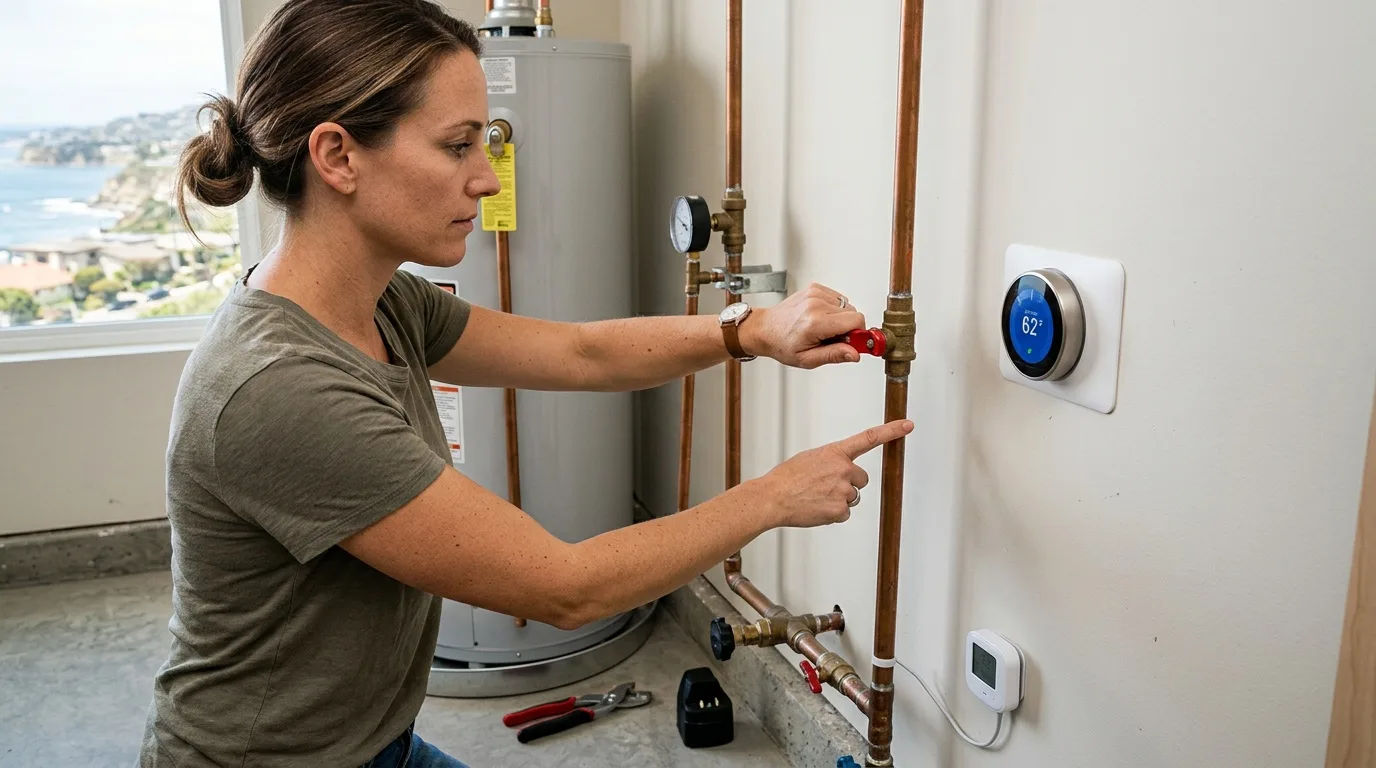
Before a vacation, most people pack suitcases and check tickets. The house gets less attention. But the trouble owners fear most when they leave is not the flight. It is the kitchen faucet that can start dripping at the worst possible moment, or a hose that bursts while nobody is home.
Every summer the same stories come up: a leak found after a week at the beach, or a fridge that shorted out and left the kitchen to be redone. This is not paranoia. If you are leaving, prepare the house as a high-risk property. That does not mean you have to be afraid. It means doing everything in advance so you do not have to worry later.
Below is what to turn off, what to leave on, and what to check when you come back to your La Jolla home.
Should I Shut Off Water Before Going on Vacation?
Turning off the water before you leave is like fastening your seatbelt on a plane. On most flights you do not need the belt, but the one time you go without it, you will remember for a long time. Water is a hidden threat. A hose can burst from age, a fitting can give way to corrosion.
That is why the advice is to turn off the water before going on vacation even if you are gone for only a couple of days.
Not everyone agrees. Some say that for very short absences you do not need to shut anything off. The risk of an accident in that case is minimal, especially if your plumbing is modern and in good condition. However, it is better to close the main water supply if the plumbing is old or unreliable, or if there is a "weak link" somewhere, for example a hose that already seeps.
Shutting off the water protects the house in case a pipe breaks or a fixture fails. If something does go wrong while you are away, a water damage restoration team in La Jolla will have far less to deal with when the supply was closed.
Can the system sit without water for weeks?
The system can stay without water for a long time, up to several months or even a year.
The pipes themselves will not suffer from having no water in them. What matters is that the system is sealed, and that no problems appear when you turn the water back on.
Still, a few things can happen:
- Dry traps. Over several months the water in the traps (the sink and toilet P-traps) can dry out, and sewer gas from the vent stack will come into the rooms. The fix: before you leave, pour a little mineral oil into each drain. It forms a film and keeps the water from evaporating. Or close the drains with stoppers.
- Corrosion. Metal pipes and shutoff valves can corrode after long contact with moisture and then with air.
- Dried seals. When water is off for a long time, the rubber seals on faucets and other fixtures can dry out and lose their elasticity.
Another risk when a system sits for a long time is corrosion inside the valves. If those are cartridge valves or ball valves made of a poor alloy, after six months in the closed position they can seize. Then the handle breaks when you open it, and you call a plumber who tells you, "You shouldn't have touched them." But that is still better than a flood.
Irrigation and fire sprinklers
Before closing the main, find out what else is fed from the same line. In many houses the irrigation system and, where there is one, a fire sprinkler system take water from it too. If you are not sure how your house is plumbed, ask the person who services those systems before you turn the main off.
Turn Off the Water Heater for Vacation
A water heater uses a huge amount of energy, keeping the water at temperature all the time. If you plan to be away for more than two days, go ahead and turn it off completely. Do not want to turn it off fully? Lower the temperature to the minimum. Many heaters have a vacation mode for exactly this.
When you get back, open the main first and run a hot faucet until the water flows steadily; then turn the water heater back on, an hour or so before the first shower. That is enough time to heat the water to a comfortable temperature.
- Electric tank. Switch it off at the unit or at its breaker.
- Gas tank. Use the vacation setting on the gas control, or the lowest setting, as the heater's manual describes.
- Tankless heater. It heats only when water runs, so if you turn off a tankless water heater for vacation, the main reason is to cut standby power and to have it off while the water supply is closed.
Washer Hoses, Faucets and the Ice Maker
The simplest thing anyone can do is shut off the water and unplug everything, especially the refrigerator if it is empty. But there is a catch: even with the valve closed, an old faucet or the washing machine can leak. That is why leak sensors are needed.
Modern washing machines with electronic controls and a display use power even when switched off. If lights or numbers are showing on the panel, the machine is drawing electricity. Unplug it.
A separate question is the refrigerator and freezer. Meat, fish, dairy in the freezer are not just a bad smell when the power goes out. It is rotting organic matter that soaks into the plastic and rubber. Even if the power is out for a few hours, an irreversible process can start, especially in summer. And if the outage is long or the appliance breaks down, the smell will be such that there is nothing left to save. Leave only food that can survive thawing.
Whether to unplug the fridge depends on how long you are gone. If you are leaving for a week or two, the refrigerator can stay on. Unplugging makes sense if you are gone for a month or longer; then empty it and leave the doors propped open. After you return, wash and dry the compartments well. If the fridge has an ice maker, close its supply valve along with everything else.
Leak Sensors
For more confidence you can install leak sensors. The better models come with a phone app: you can check that everything is fine and shut the water off remotely if there is a motorized valve on the line.
Smart leak, smoke and motion sensors are best left switched on. They help you react quickly to problems in the house and use very little power.
Humidity, AC and Mold After Vacation
An air conditioner is one of the main power users in a house. Over a week of vacation, a running AC can add a noticeable amount to the electric bill. In a coastal home, it is better to leave the AC on at a higher setting than to switch it off: it keeps the humidity down while you are away.
Also turn off heaters, fans and humidifiers for the time you are away.
Mold after vacation has a few sources. Water standing in the pipes can form deposits and mold, but this is more of a cosmetic problem that is fixed the first time the system is flushed. A refrigerator left closed and unwashed is another. If you come back to a musty smell that does not go away after airing out the house, look at mold remediation for the affected rooms.
Someone to Check on the House
It is also worth arranging for someone to check the house from time to time. Looking at the windows, checking the smell inside, the general condition: all of this helps notice a problem in time. And if something does happen, there is a chance to react to it in time.
The point is that someone can open the door quickly if something needs to be checked. Reliable neighbors, friends or relatives will do.
- Leave the keys. It does not hurt to leave keys with a trusted person.
- Record the meters. Take photos of the final readings of all the meters.
- Close the windows. Close them tightly before you go.
- Ask about the gas. If there are gas appliances in the house, use their vacation or pilot settings. If you want the gas shut off, have the gas utility or a licensed pro do it, and turn it back on when you return.
Some people switch off the main breaker before a long absence. That will cut power to routers, smart home systems and electric clocks. However, if you have systems that need constant power, such as an alarm, a refrigerator or a freezer, they have to stay on. To save energy and reduce risk, you can turn off individual circuits you are not using, such as lighting, outlets and unused appliances.
Even with the valve closed, an old faucet or the washing machine can leak. Shut off the water, unplug what does not need power, and make sure someone can get into the house quickly if something goes wrong.
The Return-Home Check
When you come back and open the water, you may find that it is a little cloudy. This passes soon. Open the valve slowly, without sharp movements, so you do not create water hammer.
Then check whether anything leaked while you were gone. The EPA WaterSense leak-check guide describes two simple tests:
- Read the water meter. Read it before and after a 2-hour period when no water is used. If the reading changes, there is probably a leak.
- Test the toilet. Put a few drops of food coloring in the toilet tank. If the color shows up in the bowl within 10 minutes, the flapper is leaking.
Also look under sinks, behind the washer and around the water heater, and smell the rooms. A sewer smell usually means the traps dried out; run water in every drain. If you find wet floors or walls, read how long drying out a house takes before deciding what to do next. When furniture and belongings have to be moved out of the way, there are pack-out services for your belongings.
Spend half an hour preparing the house for vacation. It pays off in savings and in peace of mind about your home while you are away. You can read more on our blog about home water problems, learn who we are and what we do, see what La Jolla homeowners say, or go back to the restoration company home page.